Quick Summary
A keyholding service level agreement is a written contract setting out what a keyholding provider will do, how quickly it will attend, and what happens when it fails. It should define measurable objectives, precise response clocks, an escalation procedure, key custody rules and a regular review cycle.
- Define exactly when each response clock starts, pauses and stops, since this is what gets disputed after a missed alarm.
- Measure acknowledgement, dispatch, attendance and resolution separately rather than combining them into one figure.
- Express attendance as a window rather than a fixed time, and write down all exceptions in advance with a named owner.
- Require at least a second keyholder and a supervisor in the escalation chain, so there is no single point of failure.
- Test the full escalation chain at least quarterly and review performance metrics on a fixed cycle.
Table of Contents
- What a Keyholding Service Level Agreement Covers
- Defining Measurable Service Objectives and Coverage
- Keyholding Service Response Times: Setting Realistic Targets
- Acknowledgement, Attendance and Resolution Times
- Keyholding Escalation Procedure and Alarm Response Workflow
- Key Custody, Access Control and Audit Trails
- Keyholding Service Performance Metrics and Review
- Using a Keyholding SLA Template and Booking Your Review
- Frequently Asked Questions
What a Keyholding Service Level Agreement Covers
A keyholding service level agreement (SLA) is a written contract that sets out what a keyholding provider will do, how quickly it will do it, and what happens when it fails to meet those commitments.
Most SLAs in this sector cover the same core areas. Scope defines which sites and key holdings are included. Service objectives define the measurable outcomes expected. Response standards define how quickly attendance must occur. Reporting and review define how performance is recorded and discussed.
Watch out: a keyholding SLA that lists response times but never defines the trigger for the clock starting will be disputed the first time an alarm is missed. Always specify whether timing starts at alarm receipt, at call-out, or at the moment the operator is dispatched.
Industry guidance on SLA management consistently recommends automating data collection, using real-time dashboards, and holding regular review forums. The management literature treats SLAs as living documents rather than one-off contracts, which is a useful starting point for any keyholding agreement survey of SLA management concepts and open problems.
Defining Measurable Service Objectives and Coverage
Service objectives turn a general promise such as “reliable keyholding” into something you can test. A measurable objective names the metric, the target, the measurement period and the source of the data. For example, “attendance within the agreed window for at least 95% of call-outs, measured monthly from control room logs” is measurable. “Fast response” is not.
Coverage should be stated just as precisely. Specify the sites covered, the hours of cover, the number of keyholders per site and the escalation contacts. Where a site has more than one key holder, the SLA should say whether the provider attends alone or with a named client representative.
Agreeing objectives before signing is preferable to agreeing them after the first incident. A provider that cannot describe how it will measure its own performance is unlikely to meet a target it has never tracked.
Keyholding Service Response Times: Setting Realistic Targets
Response time is the most scrutinised element of any keyholding SLA, and the most often set unrealistically.
The table below summarises the response elements a strong SLA should define and the question each one answers.
| Element | What it measures | Question it answers |
|---|---|---|
| Acknowledgement time | Receipt of alarm to operator confirmation | Has the alarm been seen? |
| Dispatch time | Confirmation to keyholder mobilised | Has someone been sent? |
| Attendance time | Dispatch to physical arrival on site | Has someone arrived? |
| Resolution time | Arrival to site secured and client informed | Is the site safe and documented? |
| Escalation trigger | Time without resolution before next contact | When does the client hear about it? |
Most generic SLA guides stop at naming these elements.
Acknowledgement time. The clock starts when the alarm signal is received by the provider’s alarm receiving centre or control room, not when the client’s phone rings.
Dispatch time. The clock starts at acknowledgement and stops when the nominated keyholder is mobilised and the dispatch is logged.
Attendance time. The clock starts at dispatch and stops at physical arrival, evidenced by a logged on-site check-in, a door contact event or a timestamped photograph.
Resolution time. The clock starts at arrival and stops when the site is secured and the client has been notified in writing.
A common pattern is to measure only attendance and treat a late acknowledgement or a slow dispatch as acceptable.
Set targets that the provider can meet on a normal day, then define what counts as an exception, such as severe weather or a road closure.
Acknowledgement, Attendance and Resolution Times
These three times measure different things and should never be combined into a single figure. Acknowledgement shows the control room is working. Attendance shows the keyholder can physically reach the site. Resolution shows the incident has actually been closed out.
Acknowledgement is usually the shortest and most tightly controlled, often measured in minutes. Attendance depends on distance and traffic, so it should be expressed as a window rather than a single fixed time. Resolution depends entirely on the incident, so the SLA should require a written incident note within an agreed period after close-out.
A common mistake is to measure only attendance and treat a late acknowledgement as acceptable. In practice, a delayed acknowledgement is often the real cause of a slow overall response.
Keyholding Escalation Procedure and Alarm Response Workflow
An escalation procedure sets out who is contacted, in what order and within what timeframe when an alarm or access request is not handled as expected.
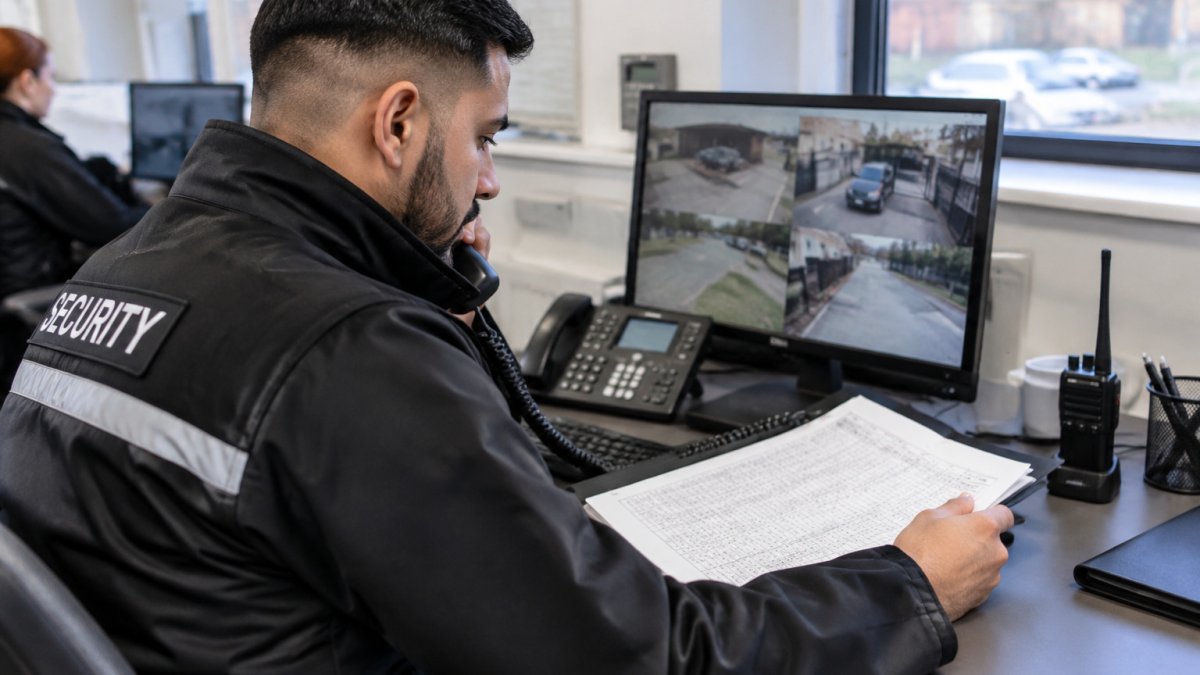
A typical workflow runs as follows: the control room receives the alarm and verifies it, dispatches the nominated keyholder, records attendance, and escalates to the client’s named contact if attendance is not confirmed within the agreed window.
That description is the easy part. What a keyholding SLA needs is the escalation matrix written as a schedule, with each stage tied to a time and an owner. A workable pattern is:
| Stage | Trigger | Action | Owner |
|---|---|---|---|
| 1 | Alarm received | Verify signal and confirm acknowledgement | Control room operator |
| 2 | Acknowledgement confirmed | Dispatch nominated keyholder and log mobilisation | Control room operator |
| 3 | Attendance window elapses without confirmed arrival | Contact keyholder for status, then dispatch second keyholder | Supervisor |
| 4 | Second attendance window elapses | Notify client’s named contact and agree next step | Supervisor |
| 5 | Site attended | Secure site, record incident note, notify client in writing | Keyholder |
The matrix should be accompanied by a contact schedule that names, for each site, the primary client contact, the secondary contact, the provider’s supervisor and the second keyholder, with out-of-hours numbers.
Watch out: an escalation procedure that names only one keyholder and one client contact is not an escalation procedure. It is a single point of failure with a heading.
Practical checks that strengthen this workflow include a current contact list held by both parties, a documented handover when keyholders change, and a test call-out at a set interval.
Key Custody, Access Control and Audit Trails
Key custody is where keyholding differs most from other security services. The SLA should state where keys are held, who may sign them out, how each movement is logged and how lost or compromised keys are reported and replaced.
An audit trail records every key issue, return and access event with a time, a name and a reason (Document Version Control and Audit Trails). Without one, it is impossible to demonstrate that a site was attended or that a key was used appropriately. The SLA should require audit records to be kept for an agreed period and made available to the client on request.
Access control measures should be proportionate. Key cabinets with logged entry, individual key tags and periodic reconciliation are common and inexpensive. Clients should ask how the provider reconciles keys against its records and how often it does so.
Keyholding Service Performance Metrics and Review
Performance metrics give the SLA its teeth. A review should cover acknowledgement and attendance performance against target, the number and nature of exceptions, escalations and missed call-outs, and any audit or key-control findings.
Reviews work best when held on a fixed cycle, usually monthly for the first six months and quarterly thereafter. The review should produce a short written record of agreed actions with owners and dates. Persistent misses should trigger a formal corrective plan, and the SLA should define what happens if that plan fails, including service credits or the right to terminate.
For a deeper view of how these metrics fit into wider security operations, see our keyholding and alarm response service. Where the review is part of a broader security contract, our crown security uk services page sets out the full range of cover available.
Using a Keyholding SLA Template and Booking Your Review
A keyholding SLA template should include the scope and site list, the service objectives and target definitions, the response standards with their trigger points, the escalation procedure, key custody and audit requirements, the review cycle, and the remedies for service failure. Each section should be specific to the sites and risks it covers.
Before signing, check that every target is measurable, every exception is written down, and both parties hold the same contact list. Ask the provider how it will evidence performance and how it will handle a missed call-out.
If you would like help adapting a template to your sites, our lock and unlock services team can review your current arrangements and advise on realistic targets. For residential properties or multi-tenant buildings, our residential security solutions page covers keyholding for homes. Broader guidance on securing remote premises is also available in our article on top security measures for remote business premises.
Get in touch with Crown Security to discuss your keyholding arrangements.
Frequently Asked Questions
What should a keyholding service level agreement include?
A keyholding service level agreement should name the parties, define the sites and key-holding scope, and set measurable response targets for alarm acknowledgement, attendance and resolution. It should also state the escalation route, the information to be recorded after each call-out, how key custody and access are controlled, the reporting cycle, and the remedies if agreed times are missed. Clear roles for the client and the provider prevent disputes when an incident occurs out of hours.
How is keyholding response time measured?
Keyholding response time is usually measured from the moment an alarm activation or call-out is received by the provider’s control room to the moment a keyholder acknowledges it and, separately, to the moment they attend site. Timestamps from the control room log and the keyholder’s arrival record should be used, not estimates. Defining each measurement point in the SLA avoids disagreement about when the clock started and stopped.
What is a reasonable alarm response time in a keyholding SLA?
There is no single fixed figure, because a reasonable target depends on the site’s risk, its distance from the keyholder base and the number of sites a provider covers. Many agreements set acknowledgement within a few minutes and attendance within a defined window, then review performance against actual data. Targets should be tested against real call-out history before they are signed, so they are achievable rather than aspirational.
How should an alarm response escalation process work?
An escalation process should set out a clear sequence: first keyholder contact, then a second keyholder if there is no answer within the agreed time, then the client’s nominated contact, and finally a supervisor or police involvement where the situation requires it. Each step should have a time limit and a named owner. Writing the sequence into the SLA, with contact details kept current, prevents calls stalling at the first unanswered number.
What information should a keyholder record after an alarm call-out?
After each call-out the keyholder should record the time of the alarm and of their arrival, the reason for the activation, the condition of the premises and any entry points, whether the site was secured on departure, and the names of any people met on site. Any police or fire service attendance and any action taken should also be logged. These records support the audit trail and give the client evidence if an incident is later disputed.
How often should a keyholding SLA be reviewed?
Most organisations review a keyholding SLA at least once a year, and sooner if the site changes, a new keyholder list is introduced, or response times are repeatedly missed. A review should compare actual call-out data against the agreed targets, check that contact details and key custody arrangements are current, and confirm that the scope still matches the site’s risks. Reviews are best held as scheduled meetings with recorded actions.
What happens if a keyholding provider misses its agreed response time?
The SLA should define what happens when a target is missed. Typical remedies include a documented root-cause review, a corrective action plan with a deadline, and in some agreements service credits or fee reductions. The client should be notified promptly of any breach. Repeated failures should trigger the review and, if necessary, the termination or renegotiation terms set out in the contract.