Table of Contents
- Manned Guarding vs Remote CCTV Monitoring: Key Differences
- How Manned Guarding Works at Logistics Facilities
- How Remote CCTV Monitoring Works for Warehouses
- CCTV Monitoring Response Times and Incident Escalation
- Hybrid Security for Distribution Centres: Combining Both Approaches
- Cost, Coverage, and Operational Resilience: A Decision Framework
- Frequently Asked Questions
Last Updated: October 5, 2026
Manned Guarding vs Remote CCTV Monitoring: Key Differences
Choosing between manned guarding vs remote CCTV isn’t about picking a winner, it’s about matching your security approach to your site’s actual risks and operations.
Manned guarding delivers physical presence, real-time decision-making, and immediate response. Remote CCTV monitoring provides detection across large areas, continuous coverage without fatigue, and scalability across multiple sites. The critical difference: a guard can intervene; a camera can only observe and alert.
At Crown Security, we’ve worked with logistics operators across the West Midlands who tried one approach, hit its limits, and realised the real solution was different. Some started with CCTV alone and couldn’t prevent determined theft or respond fast enough.
Here’s what each approach actually delivers and where it falls short.
| Aspect | Manned Guarding | Remote CCTV Monitoring |
|---|---|---|
| Physical Presence | Yes – on-site intervention | No – detection and alert only |
| Coverage Model | Single location focus | Multi-site scalability |
| Response Time | Immediate (seconds to minutes) | Dependent on escalation chain |
| Fatigue Factor | Human fatigue affects vigilance | No fatigue – 24/7 consistency |
| Cost at Scale | Increases with locations | Decreases per additional site |
| Theft Prevention | Deterrent + physical intervention | Deterrent + evidence collection |
| Access Control | Can verify identity, enforce protocols | Records access, requires verification elsewhere |
| Incident Investigation | Direct observation and reporting | Video evidence for review |
How Manned Guarding Works at Logistics Facilities
Manned guarding at a logistics hub means trained security personnel physically present at your site, conducting patrols, monitoring access points, and responding to incidents in real time.
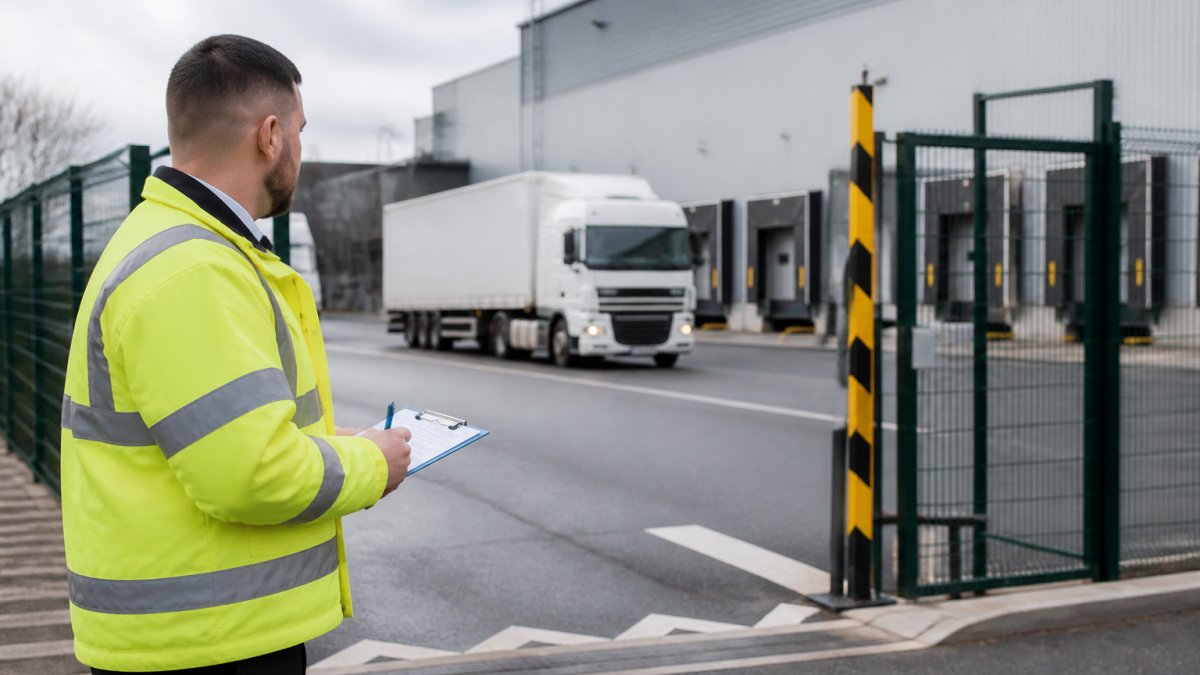
A typical deployment includes perimeter patrols of loading bays, vehicle checking at entry gates, access control at sensitive areas, and immediate response to alarms.
The strength of manned guarding is responsiveness.
The limitation is coverage. One guard can’t monitor a multi-building complex simultaneously, so round-the-clock protection across a large site needs multiple guards, significantly increasing cost.
For logistics hubs with high-value stock, frequent after-hours activity, or complex access requirements, manned guarding provides the physical control and immediate response that CCTV alone cannot deliver.
How Remote CCTV Monitoring Works for Warehouses
Remote CCTV monitoring means your site is watched continuously by trained operators in a monitoring centre, often covering multiple locations simultaneously.
This approach scales. One monitoring centre can oversee dozens of sites. Cameras don’t call in sick, don’t get tired, and don’t miss shifts.
The detection capability is strong. Modern IP cameras with analytics identify intrusions, track movement, and flag unusual activity automatically (Perimeter Intrusion Detection by Video Surveillance: A Survey).
The limitation is intervention. A camera can’t stop a theft in progress, verify identity, or enforce access protocols on the spot.
Remote CCTV also depends heavily on network connectivity, if your internet fails, live monitoring stops.
For detection across large sites, continuous recording, and scalability across multiple locations, remote CCTV is efficient. For preventing access or stopping incidents in progress, it’s limited.
CCTV Monitoring Response Times and Incident Escalation
Most comparisons stop at “guards are faster.” That’s true but unhelpful, the real question is what happens between detection and physical intervention, and who is accountable at each step. This is where a remote monitoring contract either earns its keep or quietly fails.
The escalation chain, step by step
A well-run remote monitoring service works to a defined escalation path, not an ad-hoc phone call:
- Detection, an analytics rule, perimeter beam, or operator observation flags activity, near-instantaneously for a triggered event.
- Verification, an operator reviews live and recorded footage to confirm the alert is genuine, aiming to verify within seconds, not minutes.
- Audio challenge, where the site has IP speakers, the operator issues a pre-recorded or live warning, often the single most effective deterrent a remote system has.
- Escalation, the operator contacts the agreed responder (on-site guard, mobile patrol, keyholder, or police) in the order set by your escalation matrix, not the operator’s judgement at 3 a.m.
- Dispatch and handover, responders get location, description, and access details; the operator stays on the incident, recording and updating, until handover.
What “response time” actually means
There are three different clocks, and conflating them is where operators get disappointed:
- Detection-to-verification: the monitoring centre’s own performance, hold your provider to this, and get it written into the SLA.
- Verification-to-escalation: how quickly the operator acts once a threat is confirmed. Again, an SLA item.
- Escalation-to-arrival: how long the physical responder takes to reach site, largely outside the monitoring centre’s control, depending on whether you have an on-site guard, a mobile patrol, or rely on police.
For a manned guard, the first two clocks collapse to near zero, the guard is the detector, verifier, and responder. That is the genuine advantage of on-site presence, and it is why high-value or high-risk sites often keep a guard on the highest-risk shift even when remote monitoring covers everything else.
The intervention limit, stated plainly
A remote operator cannot physically stop a theft, detain anyone, or enforce access control at a gate. The system’s deterrent value comes from the audio challenge, the visible camera, and the credible threat of a fast response, not physical capability. If your risk profile includes determined, organised intrusion or a safety threat to staff, remote monitoring alone is the wrong tool; the escalation matrix should route to a guard or patrol who can intervene.
Ask any monitoring provider for their detection-to-verification SLA in writing, their escalation matrix template, and what happens if the primary responder doesn’t answer. If they can’t answer all three, the response-time promise is marketing, not a service level.
Matching escalation to site type
A cross-dock operating through the night, a port-adjacent yard with high-value freight, and a multi-tenant hub with shared access all need different escalation paths. A multi-tenant site, for instance, may need the operator to distinguish tenants’ legitimate out-of-hours movements from genuine intrusion, so the escalation matrix must be tenant-aware, not site-wide. That configuration separates a generic monitoring contract from one built for logistics.
Hybrid Security for Distribution Centres: Combining Both Approaches
The most effective logistics security doesn’t choose between manned guarding and remote CCTV, it combines them strategically.
This addresses each approach’s core limitation: CCTV alone can’t stop theft; guards alone can’t cover a large site cost-effectively. Together they create layered security, detection, response, and evidence.
For example, a distribution centre with three loading bays might deploy one guard on night shifts (when intrusion risk is highest) and rely on remote monitoring during the day, when staff presence provides natural deterrence.
The cost is higher than either approach alone, but so is the capability: continuous detection, real-time response, and investigation-grade evidence. For high-value stock or complex logistics operations, that’s often justified.
Cost, Coverage, and Operational Resilience: A Decision Framework
Choosing between manned guarding and remote CCTV is a decision about risk, cost, and what happens when something goes wrong, plus the failure modes most comparisons ignore.
A site-type decision matrix
Logistics hubs are not interchangeable. The right model depends on what the site actually does:
| Site type | Typical risk emphasis | Often suits |
|---|---|---|
| Distribution centre (single-tenant) | After-hours intrusion, yard and loading-bay theft | Remote monitoring with a guard on the highest-risk shift |
| Cross-dock / 24-hour operation | Continuous movement, internal and vehicle theft | Layered: remote detection plus on-site presence at gates |
| Port or rail-adjacent yard | Perimeter breach, high-value freight, remote location | Remote perimeter detection plus mobile patrol response |
| Multi-tenant hub | Shared access, tenant-vs-intruder ambiguity | Remote monitoring with tenant-aware escalation rules |
| Cold storage / high-value goods | Organised intrusion, safety compliance | Manned guarding plus covert and overt CCTV |
Treat this as a starting point, not a prescription: “which is better” is the wrong question; “which fits this site type and this risk” is the right one.
A transparent cost model
Neither option has a single headline price, and any comparison that quotes one is misleading. Build your comparison across a consistent period, say three years, including:
- Staffing: guard wages, shift, holiday and sickness cover, training, licensing, and supervision. Manned guarding cost rises roughly linearly with each additional post, shift, or site.
- Equipment: cameras, analytics licences, recording and storage, access control, audio challenge units, and installation.
- Connectivity: the network link carrying video to the monitoring centre, a recurring cost and a single point of failure.
- Monitoring: the per-site or per-camera subscription, which typically falls per site as you add locations.
- Maintenance: camera cleaning, firmware, replacement, and system health checks.
- False alarms: wasted operator time and, where applicable, responder call-outs.
- Incident losses: shrinkage, theft, and disruption, the cost the whole exercise exists to reduce.
A common pattern: remote monitoring looks cheaper per site at scale, while manned guarding looks cheaper for a single small site with a short coverage window. Run the numbers for your own footprint.
Operational resilience and failure modes
This is the part most comparisons skip, and where logistics sites get caught out.
- Power and network outages: if the link to the monitoring centre drops, live monitoring stops. Ask what happens on failover, does the site record locally and backfill, is there a secondary connection, and does the centre alert you when a site goes offline?
- Camera blind spots: coverage gaps at yard corners, behind trailers, and at blind sides of buildings are common. A coverage audit, not a camera count, is what matters.
- Cyber risk: IP cameras and monitoring platforms are network devices. Default credentials, unpatched firmware, and flat networks are real vulnerabilities. Insist on segregated networks, patched firmware, and access controls.
- Backup communications: if the primary link fails, is there a secondary path, and does the alarm still reach someone?
- Contingency coverage: if a guard calls in sick or a monitoring centre has an outage, what is the fallback? A resilience plan answers this before it happens.
A practical scorecard
Whichever model you choose, measure it: incident rates, detection-to-verification times, false-alarm rates, coverage of key zones, shrinkage, and, for manned guarding, guard-post attendance and patrol completion. Review against the contract, not a feeling.
A monitoring contract without an offline-site alert, a secondary connectivity path, and a documented fallback for guard absence is not resilient. These are the failure modes that turn a security system into a false sense of security.
Compliance and privacy considerations
Camera placement, data retention, access controls, and employee privacy all carry obligations depending on your jurisdiction and site. For a logistics hub: restrict coverage of areas where staff have a reasonable expectation of privacy, set and enforce a retention period, control who can view and export footage, and document the lawful basis for monitoring. Settle these before installation, not after.
Crown Security works with logistics operators to assess these factors and design security matching actual risk, not assumed preference. The right answer is rarely “all CCTV” or “all guards”, it’s usually a specific combination at specific locations during specific hours, backed by a resilience plan and a scorecard that proves it works.
Frequently Asked Questions
Can remote CCTV monitoring replace on-site security officers at a logistics hub?
Remote CCTV monitoring and manned guarding serve different functions. CCTV provides detection and real-time visibility across large sites or multiple locations, but cannot deliver the physical presence, immediate intervention, and decision-making that trained security officers provide. Many logistics hubs benefit from both: CCTV for continuous coverage and remote assessment, guards for physical deterrence, access control, and rapid on-site response. The choice depends on your site’s risk profile, operating hours, and response requirements.
What are the advantages of combining security officers with CCTV monitoring?
Hybrid security leverages the strengths of both approaches. Guards provide visible deterrence, manage access points, and respond physically to incidents, while CCTV extends coverage across blind spots, loading areas, and perimeter zones. Remote monitoring teams can alert on-site guards to suspicious activity in real time, reducing false alarms and speeding incident response. This combination is especially effective for distribution centres handling high-value stock, managing multiple access points, or operating across extended hours.
How quickly can a remote monitoring team respond to an alarm at a warehouse?
Response time depends on the monitoring centre’s service level and your site’s escalation protocol. A professional remote CCTV monitoring team can assess an alarm and alert on-site staff or emergency services within seconds of detection. However, physical intervention, such as stopping a theft or securing an entry point, requires either an on-site guard or a mobile patrol response, which adds travel time. Define response-time targets with your provider and clarify who is responsible for each stage of the escalation.
What should a logistics business consider when choosing between manned guarding and remote monitoring?
Evaluate your site’s risk profile, occupancy patterns, and operating hours. High-value stock, frequent after-hours activity, or multiple access points often favour manned guards or hybrid deployment. Remote CCTV suits sites with good network connectivity, predictable activity patterns, and lower immediate-intervention needs. Consider staff turnover and consistency, manned guarding requires reliable staffing and protocols; remote monitoring requires stable camera networks and monitoring-centre reliability. Cost, coverage gaps, and incident-response expectations should also guide your decision.