Table of Contents
- Wireless vs Wired CCTV for Business: Key Differences at a Glance
- Reliability and Signal Stability: Where Each System Fails
- Commercial CCTV Installation Costs: What Drives the Price
- GDPR Compliance for Business CCTV: Wired, Wireless and Cloud Storage
- CCTV Maintenance and Servicing Requirements Across Both Systems
- Cybersecurity Risk Assessment: The Threat Most Buyers Ignore
- Hybrid Systems and Total Cost of Ownership: The Business Case
- Conclusion: Choosing the Right System for Your Site
- Frequently Asked Questions
Last Updated: October 3, 2026
Wireless vs Wired CCTV for Business: Key Differences at a Glance
Wireless vs wired CCTV for business comes down to a simple trade-off: flexibility against certainty. Wireless cameras install fast and reach awkward spots, while wired systems deliver uninterrupted recording and stable video. This guide from Crown Security, an SIA ACS approved provider with over 20 years of industry expertise, breaks down reliability, cost and compliance so you can specify the right setup.
The choice matters more than most buyers expect. A system that drops frames during a break-in is worse than no system at all, because it creates a false sense of coverage.
Below, we compare both approaches across the factors that actually decide the outcome: signal stability, installation labour, maintenance and long-term running costs.
| Factor | Wired CCTV | Wireless CCTV |
|---|---|---|
| Reliability | Consistent, no signal interference | Depends on Wi-Fi strength |
| Power | Continuous via PoE or mains | Battery or mains |
| Installation | Higher labour, cabling required | Fast, minimal disruption |
| Best for | Permanent commercial sites | Temporary or hard-to-cable sites |
| Scalability | Strong for large sites | Limited by network capacity |
How to Read the Comparison Table
Treat the table as a starting point, not a verdict. A wired system wins on uptime and video quality, but it costs more in installation labour and disruption.
The right answer usually depends on how long you need coverage and how critical continuous recording is. For a permanent facility running 24/7, wired infrastructure remains the commercial standard. For a temporary compound or a site where cabling is impractical, wireless fills a genuine gap.
Reliability and Signal Stability: Where Each System Fails
Wired CCTV is the more reliable option for permanent commercial properties, because it avoids Wi-Fi signal interference and draws consistent power. That combination matters when you need continuous 24/7 recording.
Wireless cameras have closed much of the reliability gap. Modern units perform well when installed correctly, as Security.org’s camera reliability analysis notes. The failure point is rarely the camera itself. It is the network.
Common causes of wireless dropouts include:
- Network congestion during peak operating hours
- Physical obstructions such as racking, steel walls or machinery
- Bandwidth shared with staff devices and point-of-sale systems
- Weak signal at the far edges of a large site
Placing a wireless camera on a congested network shared with business-critical systems is a common mistake. When bandwidth spikes, the camera drops frames or goes offline, and you discover the gap only after an incident.
Wired cameras sidestep this entirely. Power over Ethernet delivers both power and data over a single cable, so there is no battery to fail and no wireless signal to lose.
Commercial CCTV Installation Costs: What Drives the Price
Commercial CCTV installation costs are driven by cabling runs, building construction and camera count, not by the cameras alone. Two sites with the same number of cameras can differ hugely in price because of how hard it is to route cable.
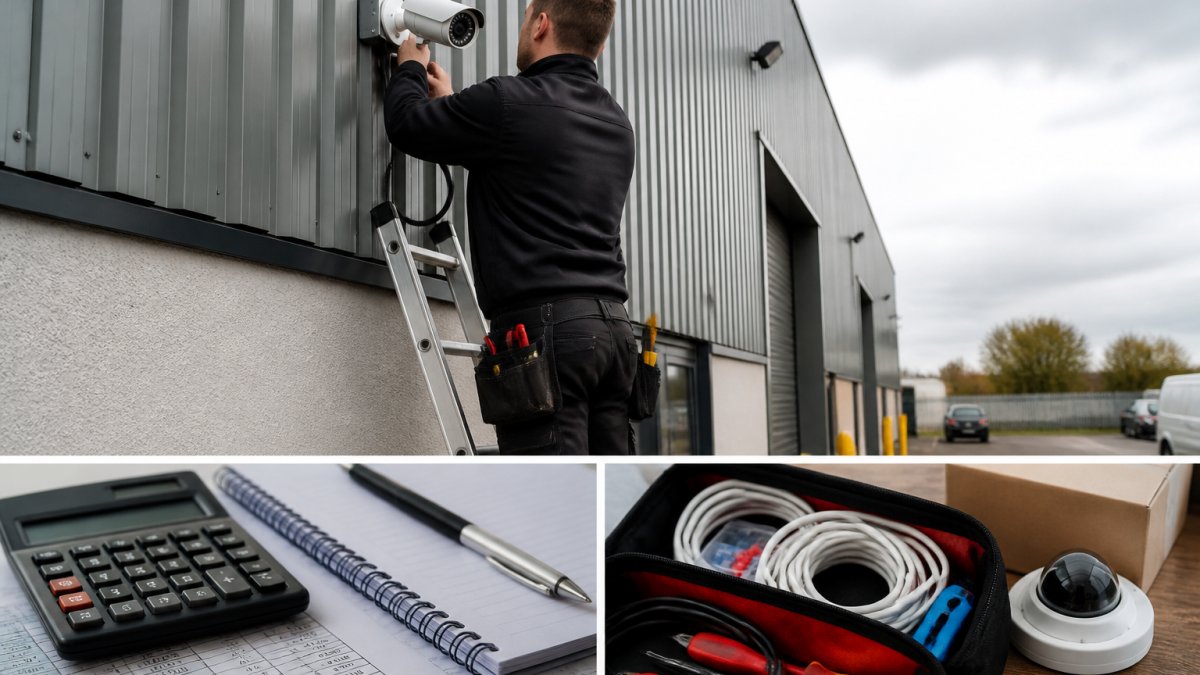
The cost drivers that matter
- Cable route length and containment. Every metre of Cat6 or fibre, plus tray, conduit and trunking, is a line item. Long perimeter runs on a distribution centre can dwarf the camera hardware cost.
- Building fabric. Drilling through fire compartments, brick, reinforced concrete or heritage stone adds labour and, in some cases, requires making good to a fire-stopping standard.
- Access and working at height. Tower scaffold, mobile elevating work platforms or out-of-hours working all carry a premium.
- Camera count and type. A basic fixed dome and a multi-sensor or PTZ unit sit at very different price points, and each additional camera adds a cable run, a switch port and a licence.
- Network and power infrastructure. PoE switches, UPS backup, cabinets and VLAN configuration are often overlooked in DIY estimates but are standard in a commercial quote.
- Commissioning and handover. Configuration, recording schedules, user accounts, documentation and training are real labour hours.
How wired and wireless quotes diverge
Wired installation carries higher upfront labour. Cable routes, containment, drilling through fire compartments and making good afterwards all add time. On a large warehouse, that labour can exceed the hardware cost. Wireless installation is faster and less disruptive, which lowers the initial outlay.
A common pattern on permanent commercial sites is that wired frequently works out cheaper over a five-year horizon, while wireless often wins on first-year cash outlay.
What to ask for in a quote
Ask any installer to separate hardware, labour, cabling and containment, network infrastructure, and any recurring subscription. A quote that bundles everything into one figure makes it impossible to compare wired against wireless fairly. Crown Security provides tailored quotes rather than fixed packages, because no two commercial sites present the same constraints.
Compare quotes on a like-for-like basis: same camera count, same retention period, same service level. The cheapest headline figure is rarely the cheapest system over its working life.
GDPR Compliance for Business CCTV: Wired, Wireless and Cloud Storage
GDPR compliance for business CCTV applies equally to wired and wireless systems. The law governs what you record and why, not how the camera connects. If your cameras capture identifiable people, you are processing personal data.
Where the systems diverge is storage. Local recording on an NVR or DVR keeps footage on site, which simplifies some data protection questions. Cloud storage moves footage to a third-party server, which means you need a data processing agreement and clarity on where that data is held.
Key obligations for any business CCTV system:
- Display clear signage so people know they are being recorded
- Document a lawful basis for processing footage
- Retain footage only as long as necessary
- Restrict access to authorised staff
- Respond to subject access requests
The ICO guidance on CCTV and video surveillance sets out these expectations in detail. Cloud-based wireless systems require particular care, because footage may leave your premises and, in some cases, the country.
CCTV Maintenance and Servicing Requirements Across Both Systems
CCTV maintenance and servicing requirements differ mainly in frequency and predictability. Wired systems need scheduled checks: lens cleaning, cable inspection, firmware updates and storage health monitoring.
Wireless systems need everything a wired system does, plus attention to batteries and network performance. A wireless camera that ran on battery through a cold winter may need replacing sooner than expected.
A practical servicing schedule looks like this:
- Monthly: check footage is recording and review alert logs
- Quarterly: clean lenses, verify coverage angles, test remote access
- Annually: inspect cabling and mounts, update firmware, audit storage retention
On hybrid sites, label every camera with its power source and network path. When a camera fails, the label tells your engineer in seconds whether to check a battery, a cable or a switch port.
Cybersecurity Risk Assessment: The Threat Most Buyers Ignore
Cybersecurity risk assessment is the step most buyers skip, and it is where wireless systems carry the greatest exposure. Every IP camera is a network device, and every network device is a potential entry point.
Wireless cameras often sit on the same network as business systems. If that camera runs outdated firmware or uses a weak default password, it becomes a way in.
A basic assessment should cover:
- Firmware update process and who owns it
- Password policy and multi-factor access
- Network segregation from business-critical systems
- Encryption of footage in transit and at rest
- Remote access controls and audit logs
Modern wireless cameras support strong encryption, and some cloud platforms push automatic security patches, which Verkada’s approach to cloud-managed security highlights as a benefit of managed systems. That advantage only holds if the platform is properly configured.
Hybrid Systems and Total Cost of Ownership: The Business Case
Hybrid systems are the answer most commercial sites actually need, and they are the configuration most buying guides ignore. Wired infrastructure covers the permanent perimeter and critical zones, while wireless cameras fill gaps where cabling is impractical. The two can run on a single recorder and a single viewing platform, which is the part competitors rarely explain.
How a hybrid system actually works
A hybrid deployment does not require two separate systems. In practice it looks like this:
- One NVR or VMS. Most modern network video recorders accept both PoE-connected wired cameras and wireless cameras that join over Wi-Fi or a wireless bridge. Both appear in the same live view and playback timeline.
- One network, segmented. Wired cameras sit on a dedicated PoE VLAN. Wireless cameras sit on a separate wireless SSID, ideally on its own VLAN, so a compromised or congested wireless link cannot reach business systems.
- One power strategy. Wired cameras draw power over Ethernet from a switch on a UPS. Wireless cameras run on battery, mains or PoE via a wireless bridge, depending on the location.
- One retention policy. Recordings from both camera types land on the same storage, so retention periods, export rules and access permissions are managed in one place.
This approach reflects what the industry already does. According to Edge Business Security Cameras’ analysis, wireless systems increasingly fill specific coverage gaps in facilities where wired infrastructure is the primary standard.
A practical TCO method
Total cost of ownership extends well beyond the purchase price. A fair comparison looks at every cost the system will incur over its working life, not just the invoice on installation day.
| Cost Category | Wired | Wireless |
|---|---|---|
| Hardware | Comparable | Comparable |
| Installation labour | Higher | Lower |
| Cabling and containment | Required | Minimal |
| Battery replacement | None | Recurring |
| Cloud subscriptions | Optional | Often required |
| Maintenance | Scheduled | Scheduled plus network |
| Network infrastructure | PoE switches, UPS, cabinets | Wireless APs, bridges, UPS |
| Cybersecurity management | VLAN and firewall configuration | Firmware, patching, encryption |
| End-of-life replacement | Cable reuse possible | Full unit replacement typical |
The pattern is consistent: wireless costs less upfront and more over time. Wired costs more to install and less to run. Over a five-year horizon on a permanent site, wired frequently works out cheaper, but the gap narrows where cable routes are unusually difficult or where a site is leased and cannot be modified.
Where hybrid wins on cost and coverage
Hybrid is often the cheapest way to reach full coverage. Instead of cabling every corner of a large site, you cable the high-value zones and use wireless for the remainder. That reduces containment and labour while keeping recording quality where it matters most.
This is where a managed provider earns its place. Crown Security designs, installs and maintains CCTV alongside manned guarding, mobile patrols and keyholding, so the camera system, the alarm response and the physical presence work as one operation rather than three separate contracts.
Model TCO over at least five years, include recurring subscriptions and battery replacement, and treat hybrid as the default starting point rather than a fallback.
Conclusion: Choosing the Right System for Your Site
Choosing between wireless and wired CCTV is not really a technology question. It is a question about how long you need coverage, how critical continuous recording is, and how much disruption your site can tolerate during installation.
For permanent commercial premises, wired infrastructure remains the benchmark. For temporary sites, restricted buildings or coverage gaps, wireless is the sensible complement. Most large facilities end up with both.
If you are weighing up a system for a site in the West Midlands, Crown Security can assess your requirements, design the right mix of wired and wireless coverage, and back it with SIA-licensed officers, 24/7 control room monitoring and reliable keyholding response. Get started with Crown Security and protect your site with a system built around how it actually operates.
Frequently Asked Questions
Does wired or wireless CCTV offer better security for commercial premises?
Wired systems are generally more secure because signals travel through physical cables that cannot be intercepted over the air. Wireless cameras rely on Wi-Fi or radio frequencies, which can be jammed or hacked if encryption is weak. For permanent business sites, wired infrastructure remains the benchmark. However, correctly installed wireless cameras with strong encryption are reliable. The deciding factor is usually site layout, budget and whether you need 24/7 recording or flexible placement.
Are wireless CCTV systems susceptible to signal interference in industrial environments?
Yes. Warehouses and factories contain metal racking, heavy machinery and dense Wi-Fi traffic that can disrupt wireless signals. This causes dropped frames, latency and gaps in recording. Wired systems avoid this because data travels through cables. If cabling is not feasible, a hybrid setup using wired cameras where possible and wireless units for remote corners is the practical compromise.
What is the typical lifespan of a professional wired CCTV system compared to wireless?
A professionally installed wired system typically lasts 7 to 10 years, with cameras and NVRs often outliving their warranty. Wireless cameras have shorter lifespans, usually 3 to 5 years, because batteries degrade and internal components are more exposed to the elements. Hardwired systems also receive firmware updates that extend usefulness. Regular servicing and firmware updates are the biggest factors in extending either system’s life.
Do wired CCTV systems comply with GDPR and data protection standards more effectively?
GDPR compliance depends on how footage is stored, accessed and retained, not on whether the system is wired or wireless. Wired systems with local NVR storage keep data on site, which simplifies control and reduces third-party transfer risks. Wireless systems using cloud storage require a Data Processing Agreement with the provider and careful attention to where servers are located. Both can comply if signage, retention policies and access controls are in place.
What are the primary installation differences between wired and wireless CCTV?
Wired installation involves running cables through walls, ceilings and conduits, which can disrupt operations and requires professional labour. It is more expensive upfront but delivers stable power and data. Wireless installation is faster and less invasive, with cameras mounted and paired to the network in hours. However, wireless units need reliable Wi-Fi coverage, and battery-powered models require periodic charging or replacement.