Table of Contents
- What Is Manned Guarding for Industrial Estates?
- Static Officers vs Mobile Patrols: Which Fits Your Site?
- Does Your Business Need Manned Guarding?
- SIA Security Officer Training Standards 2026
- Industrial Site Security Risk Assessment Template
- Security Patrol Frequency for Industrial Estates
- Cost-Benefit Analysis: Manned Guarding for Industrial Estates
- Integrating Technology with Manned Guarding Services
- Frequently Asked Questions
Last Updated: October 1, 2026
What Is Manned Guarding for Industrial Estates?
Manned guarding for industrial estates is the deployment of trained, SIA-licensed security officers to protect industrial premises, assets, and people through a visible physical presence. It covers static guarding, gatehouse duties, mobile patrols, and rapid reaction to incidents across warehouses, manufacturing plants, and distribution yards.
Static Officers vs Mobile Patrols: Which Fits Your Site?
Static officers are stationed at a fixed point, usually a gatehouse or reception, controlling access and monitoring the site directly. Mobile patrols visit multiple sites on a scheduled route, providing periodic checks rather than continuous presence. The right choice depends on your risk profile, layout, and budget.
| Factor | Static Officers | Mobile Patrols |
|---|---|---|
| Presence | Continuous, fixed location | Periodic, scheduled visits |
| Best for | High-value assets, live production | Vacant or low-risk premises |
| Access control | Full-time gatehouse duties | Lock-up and unlock only |
| Cost profile | Higher, per-site | Lower, shared across sites |
| Response | Immediate on-site | Dependent on route proximity |
Ask your provider how they measure patrol compliance. A patrol log with timestamped checkpoints is the minimum; anything less and you cannot verify the patrol happened.
Does Your Business Need Manned Guarding?
Your business needs manned guarding if it holds high-value assets, operates outside standard hours, has experienced repeated theft or trespass, or must meet insurance conditions requiring a physical security presence. Smaller sites can often justify it through a single avoided incident.
Walk through these questions honestly:
- Have you had a break-in, cargo theft, or vandalism in the last 24 months?
- Does your insurer require a physical presence or specific response times?
- Do you hold plant, machinery, or materials that are expensive to replace and easy to move?
- Is your perimeter difficult to monitor with cameras alone?
- Do you have lone workers or out-of-hours staff on site?
SIA Security Officer Training Standards 2026
All security officers deployed on industrial sites must hold a valid SIA licence, which requires completing a regulated training programme and passing a criminal record check. Licence-linked qualifications cover conflict management, physical intervention awareness, and specialist modules for door supervision or security guarding.
A common mistake is treating the SIA licence as the whole qualification. A licensed officer who has never worked your site will not know your isolation points, your fire assembly areas, or your key contacts. Insist on documented site induction for every officer, including cover staff.
Industrial Site Security Risk Assessment Template
Perimeter and boundary
- Fencing intact, at least 2 metres high, with no gaps, climbing aids, or stockpiled pallets against it
- Anti-ram bollards or barriers at vehicle entry points
- Perimeter detection (fence-mounted sensors, infrared beams) covering blind spots
- Gates closed and locked outside operating hours, with tamper-evident seals where practical
Access control and gatehouse
- Vehicle and pedestrian gates controlled, with visitor and contractor logging
- Keys, fobs, and codes issued and revoked against a written record
- Delivery drivers and hauliers verified against a booking system before entry
- Out-of-hours access restricted to named keyholders
Loading bays and yards
- Loading bays lit and covered by CCTV, with no unmonitored blind spots
- High-value loads staged inside secure compounds, not left on trailers overnight
- Yard compounds for plant, copper, and tools locked and alarmed
- Fuel and chemical stores bunded, locked, and covered by detection
Detection and surveillance
- CCTV covers entry points, yards, and high-value storage, with footage retained to a stated period
- Intruder detection on doors, windows, and internal storage areas
- Alarm signalling monitored 24/7, with a defined response protocol
- Lighting covers all approach routes and loading bays overnight
People and procedures
- Defined patrol routes with timestamped checkpoints covering the full perimeter and internal areas
- Written incident reporting and escalation process
- Fire, first aid, and evacuation procedures documented and drilled
- Lone worker and out-of-hours staff procedures in place
Insurance and compliance
- Insurance conditions for cover and response times confirmed in writing
- Any tenant or landlord obligations on shared security documented
- Waste, hazardous materials, and site-specific regulations reviewed
Scoring
- 40-48: Strong. Focus on maintaining standards and reviewing annually.
- 28-39: Gaps present. Address any zero on perimeter, access control, or detection before reducing guarding cover.
- Below 28: High exposure. Commission a professional risk assessment before setting guarding levels.
Any zero on perimeter, access control, or incident reporting should be addressed before you consider reducing guarding cover, regardless of total score. These three items carry disproportionate weight because they are the controls intruders target first.
Re-run the assessment after any change of tenant, layout, or stock profile. Industrial estates change occupancy frequently, and a control that was adequate last year may not match this year’s risk.
Security Patrol Frequency for Industrial Estates
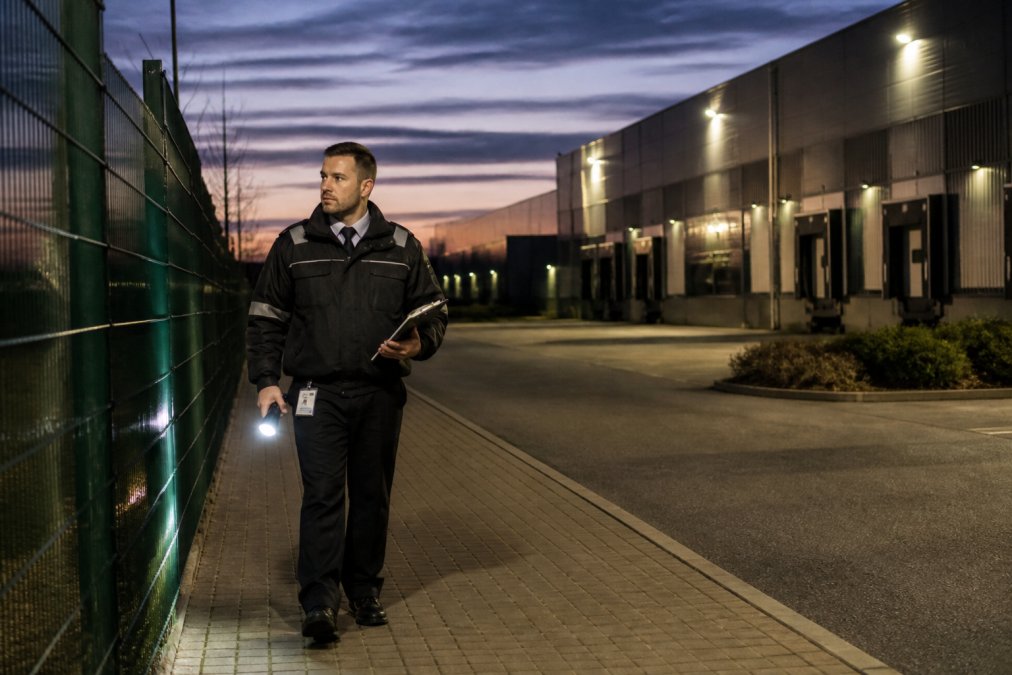
Security patrol frequency for industrial estates typically ranges from hourly checks on high-risk sites to two or three visits per night on low-risk premises. The right frequency is determined by asset value, site size, and insurance requirements, not a fixed industry standard.
A practical starting point:
- High-risk sites (high-value stock, live production, prior incidents): hourly internal and perimeter checks
- Medium-risk sites (mixed occupancy, moderate assets): checks every two hours
- Low-risk sites (vacant units, low-value storage): two to three visits per night, with random timing
Cost-Benefit Analysis: Manned Guarding for Industrial Estates
1. Estimate annual guarding cost
2. Estimate the cost of one serious incident
- Stolen assets: plant, copper cabling, tools, stock, or a loaded trailer
- Downtime: production halted while equipment is replaced or a unit is secured
- Insurance excess: the amount you pay before the policy responds
- Premium impact: a claim often raises the following year’s premium and can affect terms
- Reputational and contractual: missed customer deadlines, penalty clauses, or a tenant withholding rent
3. Estimate incident probability
4. Compare
The insurance mechanism
Build the case in this order: incident cost, then probability, then insurance conditions, then premium effect. The insurance answer frequently makes the decision for you, because it converts a discretionary spend into a condition of cover.
For many operations managers, the deciding factor is insurance. Some policies reduce premiums when a site has documented guarding and access control, which offsets part of the cost.
Integrating Technology with Manned Guarding Services
The most effective industrial security strategies combine experienced personnel with integrated technology such as CCTV and access control systems, according to Titan Security Europe’s 2026 physical security trends guide. Technology extends what each officer can monitor; officers respond to what technology detects.
Practical integrations worth considering:
- CCTV with remote monitoring lets a control room watch multiple sites while officers respond on the ground.
- Access control systems log every entry, giving officers verified data rather than assumptions.
- Intruder detection triggers alarm response and directs patrols to the right area.
- Incident reporting software turns patrol logs into data you can act on.
Frequently Asked Questions
What are the benefits of manned guarding for industrial estates?
Manned guarding provides a visible physical presence that deters theft, vandalism and trespass on industrial premises. Officers conduct patrols, monitor access control and respond to incidents in real time. The global manned guarding market is valued at USD 64.44 billion in 2026 and is projected to reach USD 97.56 billion by 2030, reflecting growing demand. For industrial sites, the key benefit is protecting high-value assets, machinery and infrastructure that alarms alone cannot safeguard.
How does SIA licensing impact manned guarding services?
Every security officer deployed on an industrial site must hold a valid SIA licence, which requires completing approved training, passing a criminal record check and meeting identity requirements. SIA-licensed officers are trained in conflict management, physical intervention and emergency response. Using unlicensed personnel exposes your business to legal liability and invalidates insurance cover. Always verify that your provider holds SIA ACS approval, which confirms the company meets the regulator’s standards for management and operations.
What is the difference between mobile patrols and static manned guarding?
Static guarding places an officer at a fixed position, such as a gatehouse, for the duration of a shift. Mobile patrols involve officers visiting multiple sites on a scheduled or random basis, checking perimeter security, responding to alarms and completing patrol logs. Static guarding suits high-risk sites needing constant presence, while mobile patrols work well for lower-risk or multi-site operations. Many industrial estates use a blended approach combining both for cost-effective coverage.
How do you conduct a security risk assessment for an industrial site?
A risk assessment starts with a site survey identifying entry points, perimeter vulnerabilities, high-value storage areas and existing security measures. You then assess the likelihood and impact of risks such as cargo theft, trespass, vandalism and operational disruption. An industrial site security risk assessment template should include sections for perimeter security, access control, lighting, CCTV coverage, patrol routes and incident reporting procedures. Review the assessment annually or after any incident to keep it current.
What are the legal requirements for security personnel in the UK?
Security personnel must hold a valid SIA licence under the Private Security Industry Act 2001. Providers should be SIA ACS approved, which demonstrates compliance with the regulator’s standards. Officers must follow health and safety legislation including the Health and Safety at Work etc. Act 1974, and sites must comply with data protection law when operating CCTV. Employers also have duties under the Management of Health and Safety at Work Regulations 1999 to assess risks to security staff.
How can manned guarding reduce insurance premiums for industrial estates?
Insurers assess risk based on the security measures in place. Sites with SIA-licensed manned guarding, documented patrol logs, access control and CCTV coverage present a lower risk profile than unguarded premises. This can lead to reduced premiums or more favourable policy terms. Some insurers require evidence of regular patrols and incident reporting before offering cover. Speak to your broker about how a manned guarding contract could affect your policy, and keep detailed records of security protocols and patrol activity.
How often should security patrols take place on an industrial estate?
Patrol frequency depends on site size, risk level and the value of assets stored. High-risk sites with valuable machinery or stock typically need patrols every 1-2 hours, while lower-risk premises may suit 3-4 hourly checks. Overnight and weekend patrols are critical because industrial estates are most vulnerable when unoccupied. A risk assessment should determine the schedule, and patrol logs should record every check to provide an audit trail for insurers and management.