Quick Summary
Security team burnout is reduced by cutting alert fatigue, clarifying roles, and running shift patterns that allow proper rest. Teams should also track the early warning signs and measure progress with a stress risk assessment, a short quarterly pulse survey, and operational indicators like overtime and absence.
- Limit after-hours alerts and simplify security protocols to reduce cybersecurity fatigue.
- Watch for early signs such as missed checks, slower responses, and rising unplanned absence.
- Run a stress risk assessment and a six-to-ten question anonymous pulse survey every quarter.
- Publish consistent rotas, allow adequate rest between shifts, and limit consecutive night shifts.
- Share survey results with staff and agree one or two actions per cycle to build trust.
Table of Contents
- What Drives Burnout in Security Teams
- Spotting the Warning Signs Early
- Workplace Stress Risk Assessment for Security Operations
- Reducing Workload Through Automation and Prioritisation
- Security Shift Pattern Best Practices
- Security Officer Mental Health Support That Retains Staff
- Planning Your First 90 Days of Burnout Reduction
- Frequently Asked Questions
What Drives Burnout in Security Teams
Security team burnout builds faster than in most departments. The work is constant, the stakes are high, and the pressure rarely switches off. The same pressures tend to come up again and again across security operations.
Burnout rarely has one cause. It usually builds from a few workplace conditions that stack on top of each other. Two of the most common are alert fatigue and unclear roles.
Alert fatigue and excessive security alerts
Alert fatigue happens when staff receive so many notifications that they stop reacting to any of them. A single real threat can get lost among hundreds of false alarms.
Recent research describes a related problem called cybersecurity fatigue. A 2025 study by Researchers led by F. Mizrak, on digital detox and cybersecurity fatigue found that limiting after-hours alerts and simplifying security protocols can help reduce it. The same work links fatigue to burnout, lower productivity and psychological strain.
For an operations manager, the lesson is simple. Fewer, better alerts protect both the team and the site, and they are one of the most practical ways to prevent security team burnout.
Spotting the Warning Signs Early
Burnout seldom arrives all at once. It creeps in, and the signs are easy to dismiss as a busy week.
Watch for these early signals:
- Staff missing or ignoring routine checks
- Slower response times on alarms or incidents
- Increased sick days or unplanned absence
- Irritability during handovers
- Staff volunteering for fewer tasks or avoiding overtime they once took willingly
Spotting these early gives you time to act. A short conversation with the affected officer often reveals whether the cause is workload, rota pressure or something personal.
Workplace Stress Risk Assessment for Security Operations
A stress risk assessment gives you a structured way to find pressure points before they become problems, but a one-off review tells you little. The stronger approach is a repeatable measurement framework that combines a formal risk assessment with a short pulse survey and a small set of operational indicators. That combination turns a vague worry into a trend you can act on.
Run a formal stress risk assessment
Employers are expected to assess the risks arising from work activity, and the Health and Safety Executive’s management standards provide a recognised structure for stress (Stress and mental health at work). Apply that structure to each post and shift pattern. Ask where officers are stretched, which sites carry the heaviest load and where incidents cluster. Then gather confidential feedback from the team, because staff often know exactly where the strain sits. Record each finding, assign an owner and set a review date.
Add a short pulse survey
A pulse survey of six to ten questions, run every quarter, gives you a comparable signal over time. Keep it anonymous and short enough to complete in five minutes. Sample questions include:
- In the past two weeks, how often have you felt unable to switch off after a shift?
- How manageable was your alert volume on your last five shifts?
- Do you have enough rest between shifts to recover?
- When you raised a concern, did you feel it was acted on?
- How clear are your responsibilities and escalation routes?
Score responses on a simple scale, publish the aggregate to the team and agree one or two actions per cycle. The point is not the score itself but the direction of travel across quarters.
Track operational indicators alongside survey results
Survey sentiment can drift without anyone noticing, so pair it with hard indicators already held in rota, incident and HR systems:
- Overtime hours per officer per month
- Alert volume per shift and the proportion classed as false positives
- Unplanned absence and short-notice sick leave
- Response times on alarms and incidents
- Voluntary attrition and exit-interview themes
- Time from incident close to the officer’s next shift
Review these monthly at management level and quarterly with the team. A rising overtime figure alongside falling survey scores is an early warning that a rota or staffing change is needed before people leave.
Watch out: a survey that is run once and never reported back to staff will reduce trust rather than build it, so commit to sharing results and actions before you launch the first cycle.
The article sets out a few key indicators to track alongside survey results, which can be summarised as follows.
| Indicator | Where it comes from | Why it matters |
|---|---|---|
| Overtime hours per officer per month | Rota and HR systems | Rising overtime signals strain before staff leave |
| Alert volume per shift | Monitoring systems | Shows whether alert fatigue is building |
| Unplanned absence | HR records | Flags short-notice sick leave |
| Response times on alarms | Incident records | Shows slower reactions under pressure |
| Voluntary attrition | HR and exit interviews | Reveals whether staff are leaving |
| Pulse survey trend | Quarterly anonymous survey | Shows the direction of travel over time |
Reducing Workload Through Automation and Prioritisation
Not every task needs a person. Routine monitoring can often be shared with technology or outside support, freeing experienced staff for work that genuinely needs them.
Mobile patrols are one option. They take routine checks off in-house teams and give regular coverage across a site. Our mobile patrol services overview
Prioritisation matters just as much. Rank alerts and tasks by real risk, so the most serious incidents always get attention first. Automation is not always the answer, though. Poorly set up systems can add noise rather than remove it, so test any change on a small scale first.
Security Shift Pattern Best Practices
Shift design has a large effect on fatigue. Long runs of night shifts, short rest periods and last-minute changes all wear people down.
Good shift patterns tend to share a few features:
- Consistent rotas published well in advance
- Adequate rest between shifts
- Clear handover routines so nothing gets lost
- Limits on consecutive night shifts
- Backup cover planned for sickness and leave
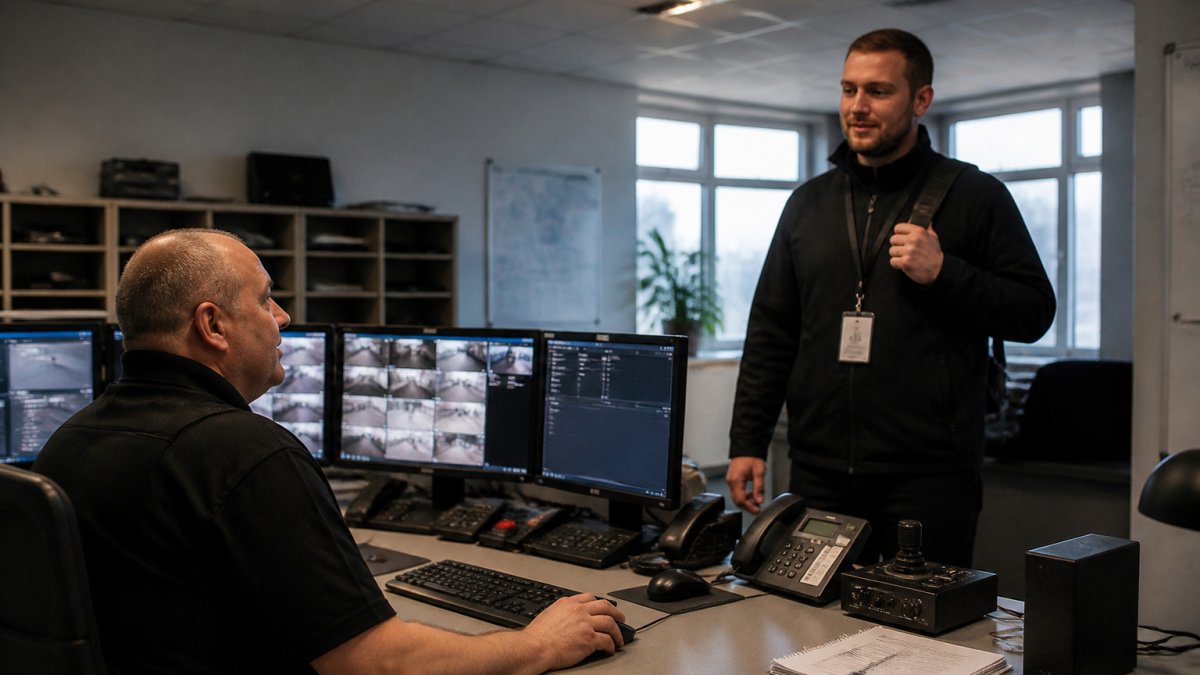
A regular control room presence can also take pressure off overnight staff. A 24-hour control room can share monitoring duties and provide support during quiet hours. control room monitoring and emergency response
Security Officer Mental Health Support That Retains Staff
Officers who feel supported stay longer. Mental health support is not only a welfare issue, it also protects your investment in trained people.
Practical steps include:
- Regular one-to-one check-ins with a line manager
- Access to confidential support services
- Post-incident debriefs after difficult call-outs
- Clear routes for raising concerns without fear
Lone working adds its own pressure (Protecting lone workers: How to manage the risks of working alone). Lone worker monitoring gives staff a safety net and reassures them that help is one button away. lone worker monitoring for employee safety
Planning Your First 90 Days of Burnout Reduction
A plan works best when it is broken into stages, each with a named owner, a milestone and a way to judge whether it worked. The structure below assumes a small steering group: an operations manager as sponsor, a rota or resource planner, a team leader from the control room and a representative from HR or health and safety.
Days 1 to 30: Assess
- Run the stress risk assessment across all posts, owned by the health and safety lead, with findings recorded by day 21.
- Launch the first pulse survey, owned by HR, with a target response rate agreed in advance.
- Pull baseline indicators for overtime, alert volume, absence and attrition, owned by the resource planner.
- Review alert volumes and shift patterns against the HSE management standards, owned by the operations manager.
Milestone: a written baseline report agreed by the steering group by day 30.
Days 31 to 60: Act
- Remove or tune the noisiest alerts and simplify protocols, owned by the control room team leader, with a before-and-after alert count.
- Adjust rotas to build in proper rest and limit consecutive night shifts, owned by the resource planner.
- Agree clear roles and escalation routes and publish them, owned by the operations manager.
- Set up post-incident debriefs and a confidential route for raising concerns, owned by HR.
Milestone: each action has an owner, a completion date and a measure attached.
Days 61 to 90: Review
- Re-run the pulse survey and compare scores with the baseline, owned by HR.
- Check whether overtime, sickness, response times and turnover have moved, owned by the resource planner.
- Hold a team review and adjust what is not working, owned by the operations manager.
- Set the next quarter’s priorities and confirm the review cadence, owned by the steering group.
Milestone: a short review note showing what changed, what did not, and the next set of actions.
Evaluate progress honestly
Judge the plan on a small number of indicators rather than a long list: overtime hours per officer, alert volume per shift, unplanned absence, voluntary attrition and the pulse survey trend. If indicators have not moved by day 90, revisit the assessment rather than adding more initiatives on top.
Watch out: a plan with no named owner for each action tends to stall at the assessment stage, so assign ownership before the first meeting ends.
Frequently Asked Questions
What are the primary causes of burnout in security teams?
Burnout in security teams usually comes from a combination of sustained alert volume, long or irregular shifts, unclear role boundaries and limited recovery time after serious incidents. Research on cybersecurity fatigue links these pressures to reduced productivity and psychological strain. Addressing the root causes, rather than only the symptoms, produces the most durable improvement.
How does the SIA licensing process affect security staff wellbeing?
Security Industry Authority licensing sets minimum standards for those working in the sector, which gives employers a clear baseline for training and conduct. For staff, licence renewal and the requirement to remain fit to work can add administrative pressure, particularly for officers moving between sites or roles. Employers can reduce this strain by tracking licence expiry dates in advance, arranging renewal time during paid working hours and making sure officers understand what their licence permits.
What are the legal responsibilities of employers regarding workplace stress in the UK?
Employers in Great Britain have a legal duty to assess and control risks to employees’ health, including stress. The Health and Safety Executive recommends a structured stress risk assessment, covering demands, control, support, relationships, role and change. Employers should record findings, act on them and review them regularly, particularly after incidents or staffing changes.
How do you identify early signs of burnout in manned guarding teams?
Early signs include rising sickness absence, more errors in logs or patrol records, withdrawal from handovers, irritability with colleagues and reluctance to take leave. Managers can track these alongside shift data, such as consecutive long shifts or missed rest periods. Regular one-to-one check-ins give officers a safe place to raise concerns before they lead to resignation or a safety incident.